
Policy Co-Design
Guide, Diagrams, and Worksheet
Introduces our original co-governance method
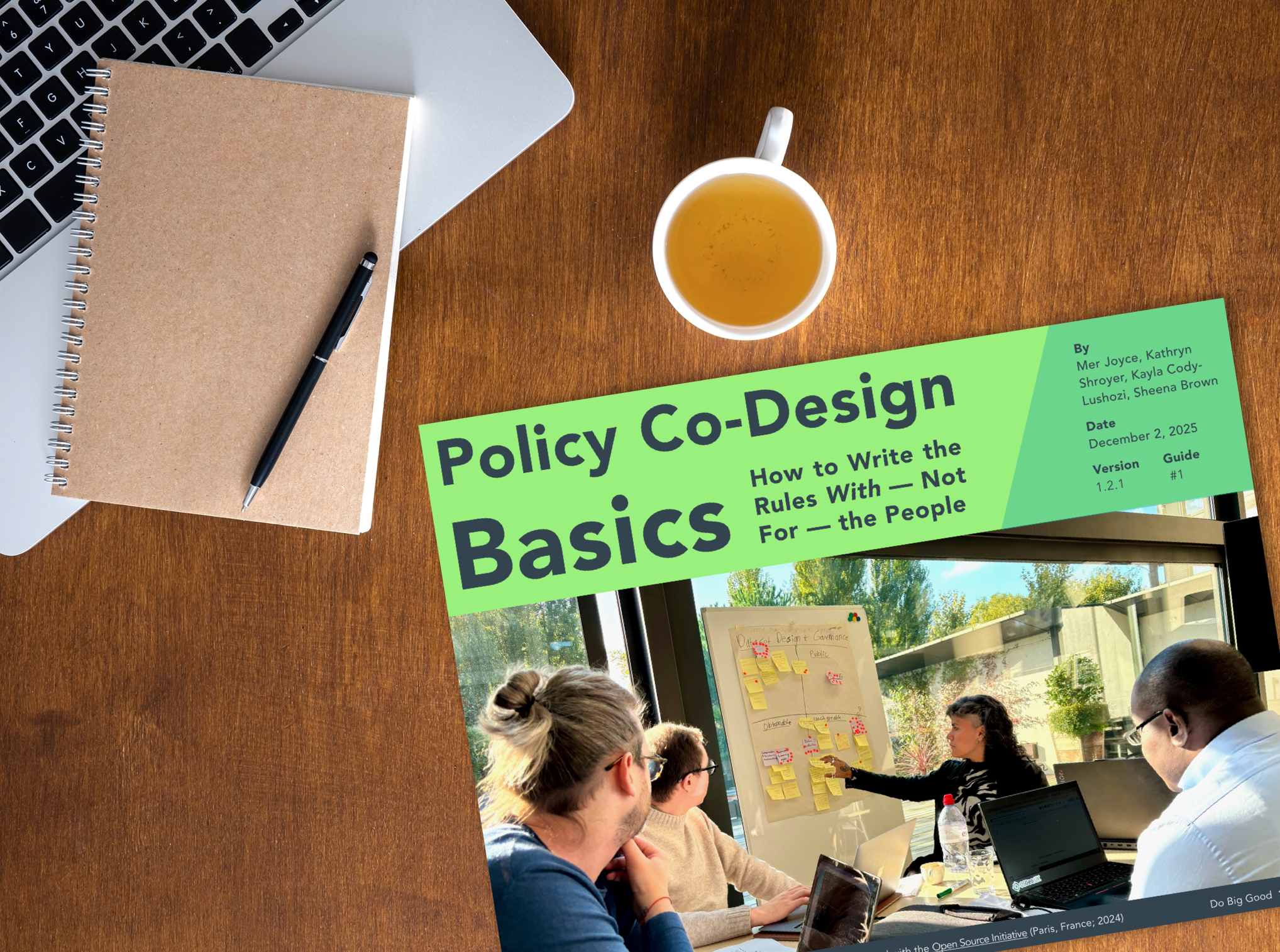
Policy Co-Design Basics
A short handbook for community leaders, practitioners, elected officials, and organizers introduces our co-governance method in which institutions and communities write the rules together. Illustrated with photos from our projects, this participatory policymaking guide defines and illustrates key terms and our process.
🥂 It pairs well with the Co-Governance Tool for Multi-Racial Democracy by Race Forward and the Participatory Policy-Making Toolkit by the Participatory Budgeting Project and Center for Popular Democracy.
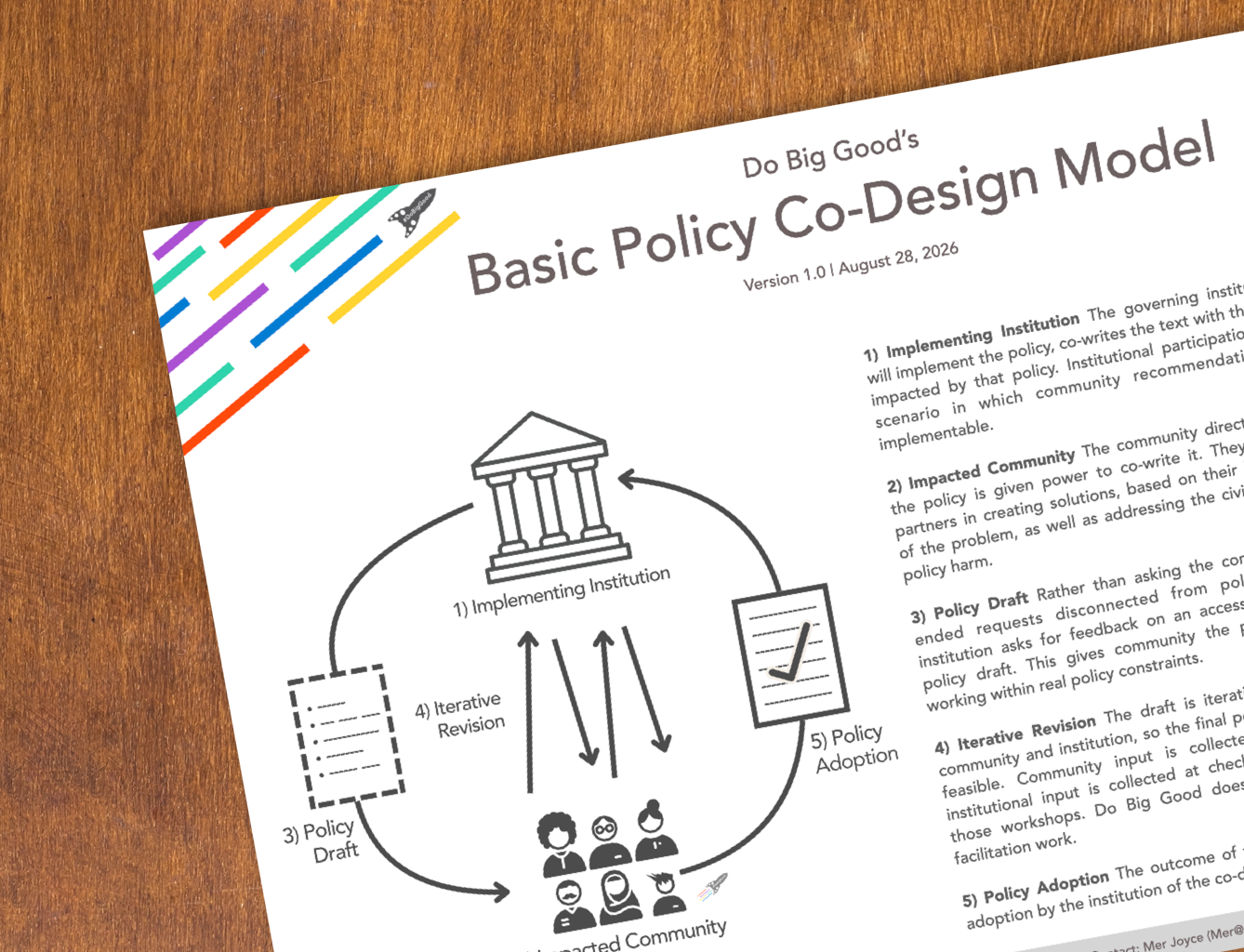
Basic Policy Co-Design Model
A companion to the guide, this diagram shows the five fundamental components of a policy co-design process: institution, community, draft, iteration, and adoption.
🥂 It pairs well with the Detailed Policy Co-Design Model (below), which provides greater detail on how a policy co-design process is initiated and how the policy draft is made accessible for the impacted community.
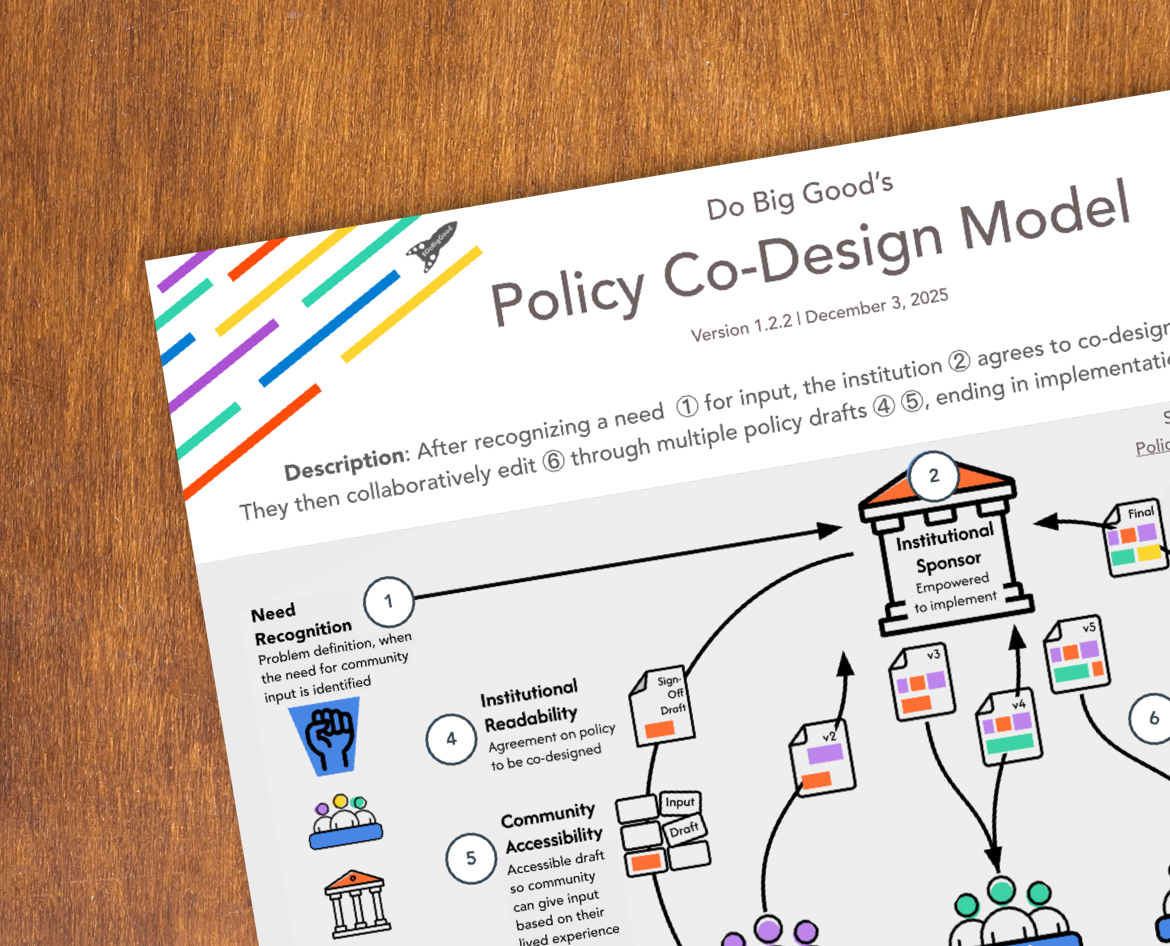
Detailed Policy Co-Design Model
A companion to the guide, this diagram shows the seven phases of a policy co-design process, which is centered on a double feedback loop between the implementing institution and the community.
🥂 The model pairs well with the Policy Co-Design Checklist (below), which provides describes each step.
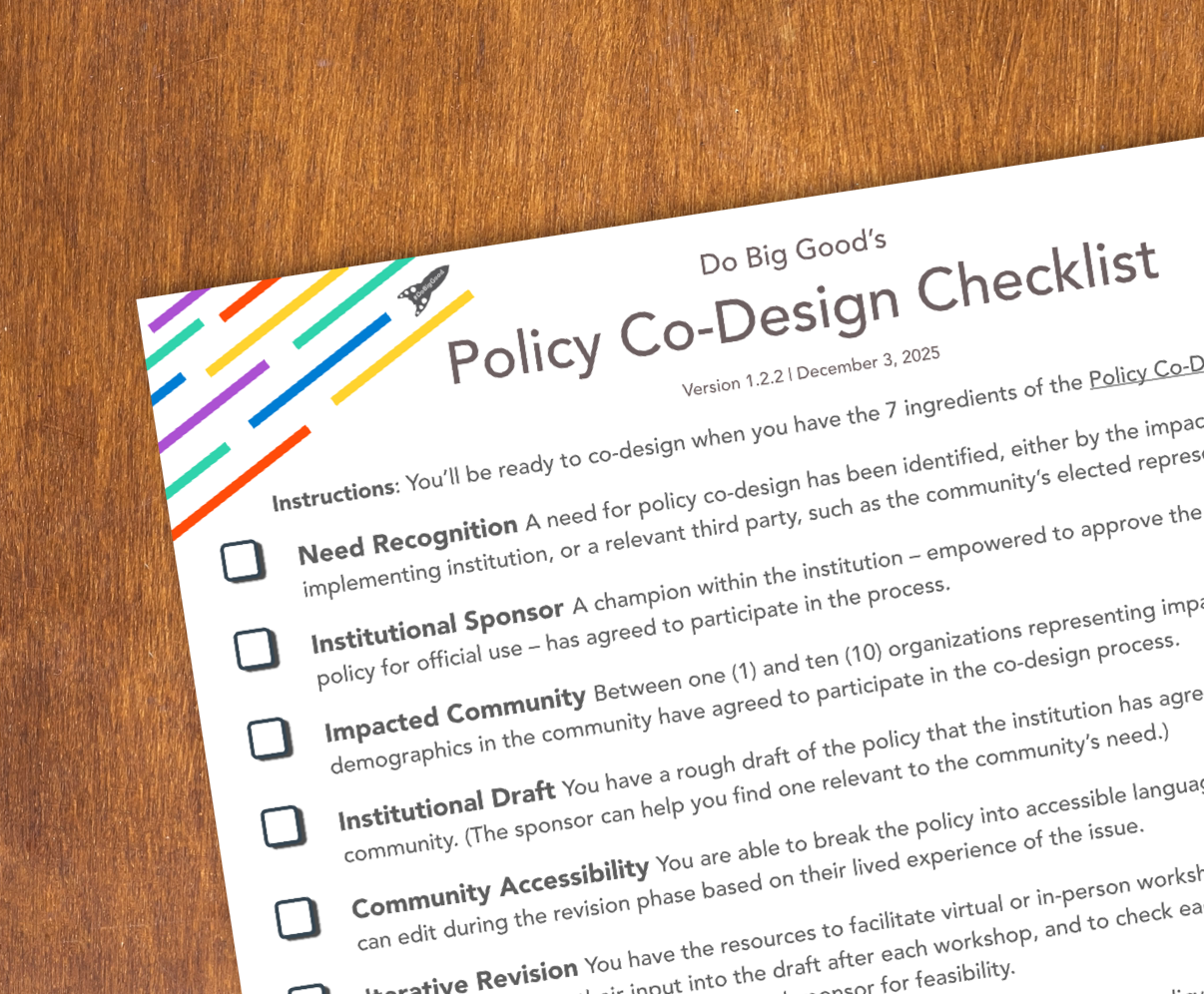
Policy Co-Design Checklist
A companion to the guide, this worksheet helps those who want to initiate a policy co-design process assess their level of readiness by focusing on their ability to implement the seven basics phases of the process.
🥂 The worksheet pairs well with the Detailed Policy Co-Design Model (above), which visualizes each step.
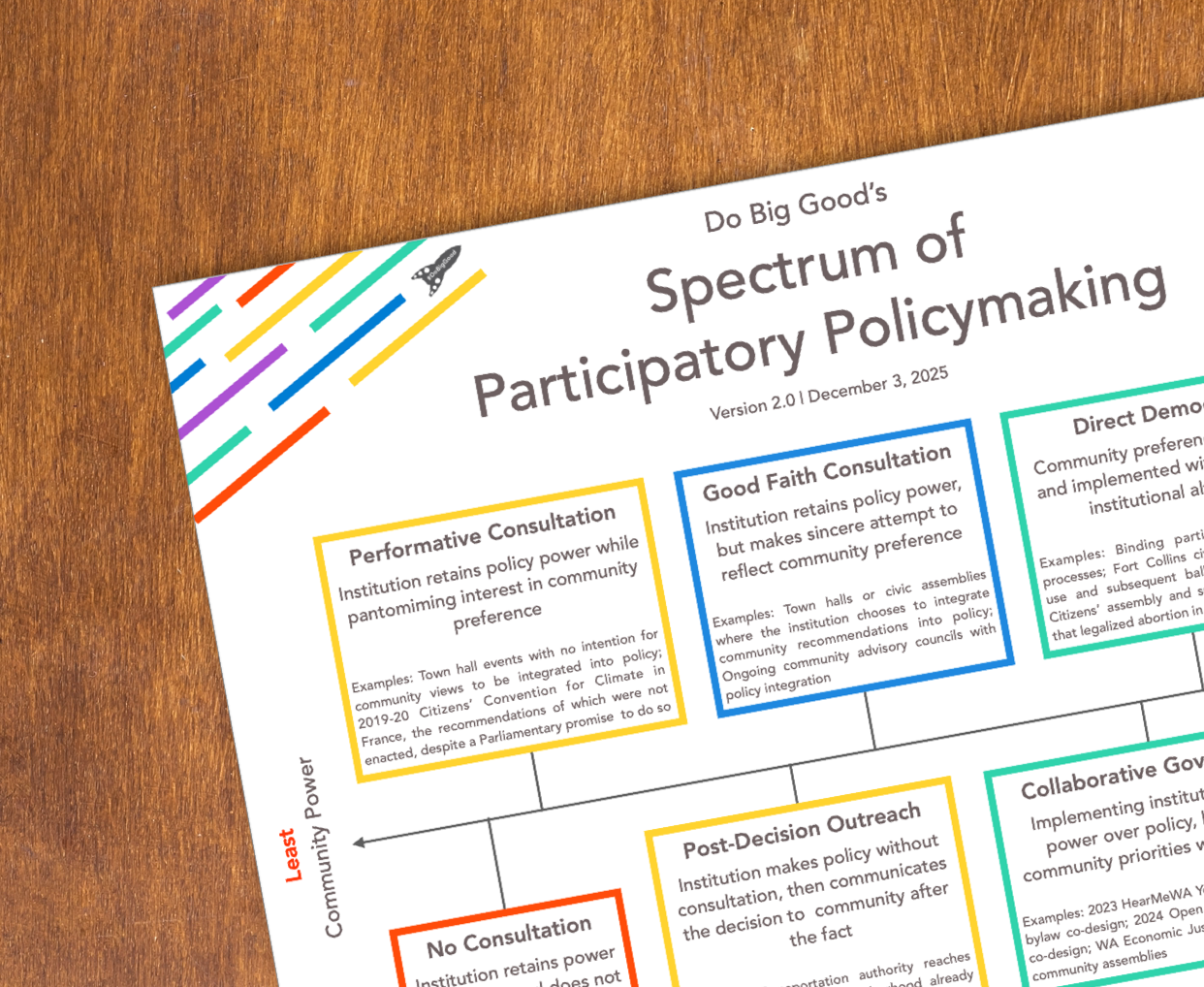
Spectrum of Participatory POlicymaking
A companion to the guide, this diagram shows where policy co-design is situated in the broader power-sharing spectrum, from least to most community power over policy. The diagram includes examples from around the world, illustrating participatory policymaking at different points on the spectrum.
🥂 It pairs well with the Spectrum of Community Engagement to Ownership by Rosa Esperanza González of Facilitating Power
Further Reading
To learn about the lineage and foundations of policy co-design, we recommend:
Equity-Centered Community Design Field Guide (2018), handbook by method developers Creative Reaction Lab
Design Justice: Community-Led Practices to Build the Worlds We Need (2020), book by scholar Sasha Costanza-Chock
Participatory Policy-Making Toolkit (2021), a guide by Antonnet Johnson, Phd. of the Participatory Budgeting Project and Kate Hamaji of the Center for Popular Democracy.
The Spectrum of Community Engagement to Ownership (2021), participation tool by Rosa González of Facilitating Power
Co-Governance Tool for Multi-Racial Democracy (2025), guide by racial equity nonprofit Race Forward
Fighting Americans’ Civic Trauma Will Require a New Approach to Governance (2026), op-ed by civic strategist Niketa Brar
Acknowledgements:
The guide and its subsidiary materials were made in consultation with our friends and colleagues Christine Ortiz, Faduma Fido, Brendan Halloran, Kate Hamaji, Dylan Cate, Curtis Atkisson, Jonathan Brack, Cédric Fettouche, Felix Hähnlein, Kristina Podnar, Saara Kamal, Oliver Stephenson, Nick Vidal, Jon Garfunkel, Brenda Ray Scott, Carrie Basas, Lindsay Morgan Tracy, Cole Speidel, and Justin Reedy.
Double Diamond Model
Diagram
Visualizes the design process
Diagram: Double Diamond
The work of social change often requires groups to solve problems together. Created in 1996 by linguist Béla H. Bánáthy, the Double Diamond is a design process model that illustrates divergence (learning, brainstorming, exploring) and convergence (prioritizing, synthesizing, choosing) in group problem-solving. There are many versions of this model, from the simplest to the most complex. We decided to make our own version, which we think hits the sweet spot between detail and simplicity.

Cynefin Framework
Diagram and Video
Offers a framework for understanding social complexity

Diagram: Cynefin Framework
Developed by David Snowden in 1999, the Cynefin framework (meaning “habitat” in Welsh) is a typology of social systems that provides guidance on how to operate strategically in each.
At Do Big Good, our practice focuses on complex systems (upper-left quadrant), where emergent practice, experimentation, and adaptation are required for success.
Video: Cynefin Framework Explained
As guest expert Jessica Conrad of the Garfield Foundation explains, there are no predetermined steps that enable us to achieve outcomes in complex systems. However, we can succeed in our social change goals by making small and low-risk tests of our strategy and assumptions.
Testing assumptions, learning from the results, and adapting quickly are core to Do Big Good’s advisory services for clients implementing social change projects.